RO Systems vs. Pitcher Filters: Which One Actually Removes Contaminants?
If your tap water tastes like chlorine or you are concerned about what might be hiding in your drinking water, buying a filter seems like an obvious solution. The bigger question is what kind of filter you actually need.
Walk through almost any grocery or home improvement store and you will find inexpensive water filter pitchers promising cleaner, better-tasting water. At the other end of the spectrum are professionally installed reverse osmosis systems, commonly called RO systems, that use multiple stages of filtration to purify drinking water.
Both can improve water quality, but they are not doing the same job.
For Dallas-Fort Worth homeowners concerned about contaminants such as lead, PFAS, nitrates, fluoride, dissolved solids, chemicals, and microplastics, understanding the difference between a pitcher water filter and a reverse osmosis system can help you make a much better decision.
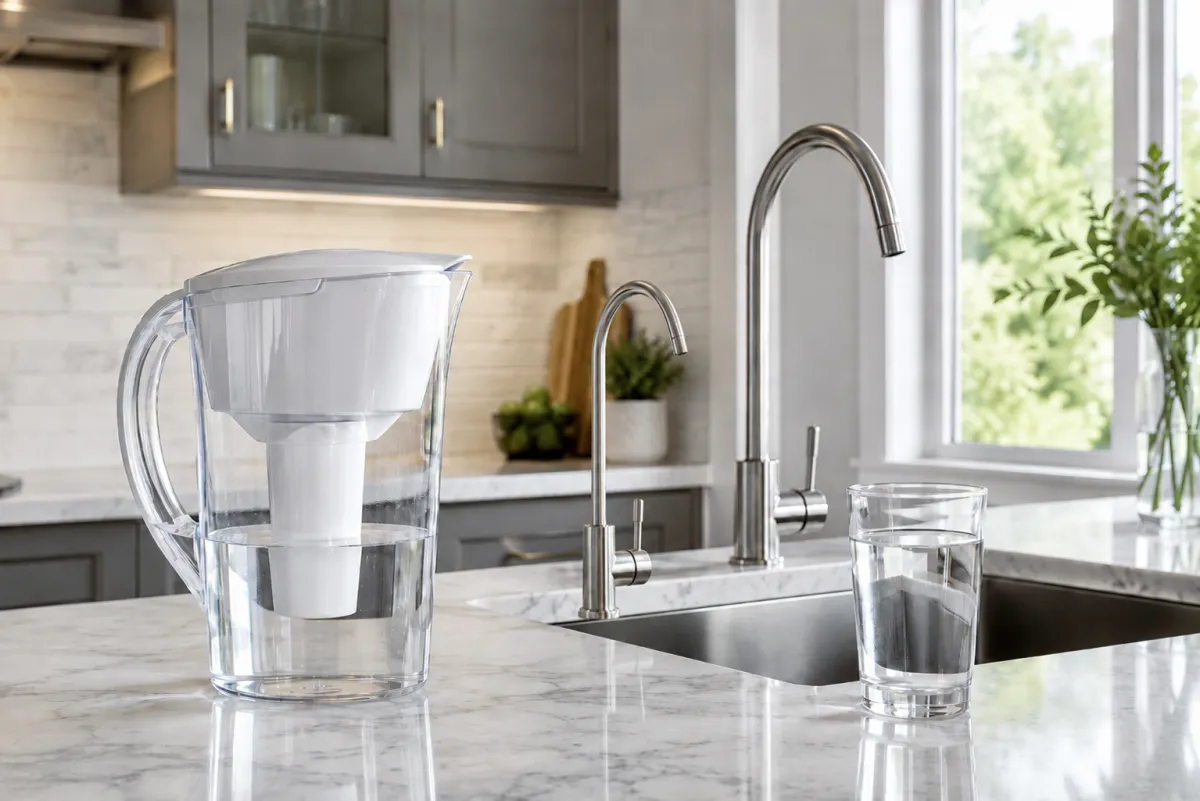
How Does a Pitcher Water Filter Work?
Most water filter pitchers use an activated carbon filter, sometimes combined with an ion-exchange material.
When you pour tap water into the top of the pitcher, gravity slowly pulls the water through the filter cartridge before it reaches the reservoir below.
Activated carbon is particularly useful for improving water's taste and odor. Depending on the specific filter and its certifications, a pitcher may reduce contaminants such as:
Chlorine
Certain odors and unpleasant tastes
Some metals
Some organic compounds
Certain contaminants specifically listed by the manufacturer
That can make a noticeable difference if your biggest complaint is that your municipal water smells or tastes heavily chlorinated.
The important thing to understand is that not every pitcher removes the same contaminants.
Consumers should always check the manufacturer's NSF/ANSI certifications and contaminant reduction claims rather than assuming that a pitcher labeled "filtered water" removes everything they are concerned about.
Where Pitcher Filters Fall Short
A pitcher filter is designed to be compact, inexpensive, and convenient. Those same characteristics limit what it can accomplish.
Unlike a reverse osmosis system, most pitchers do not force water through an extremely fine membrane. That means many dissolved substances can remain in the water even after filtration.
Depending on the particular filter, pitcher systems may provide limited or no reduction of contaminants such as:
Dissolved salts and minerals
Nitrates and nitrites
Fluoride
Arsenic
Certain PFAS compounds
Some heavy metals
Total dissolved solids
Other microscopic dissolved contaminants
Filter life is another consideration.
As water passes through a pitcher cartridge, the filtration media eventually becomes exhausted. A filter that should have been replaced weeks ago may provide very different performance than a fresh cartridge.
A pitcher can still be useful. It simply should not automatically be considered a substitute for a more advanced drinking water purification system.
How Does a Reverse Osmosis System Work?
A reverse osmosis water filtration system takes a much more comprehensive approach.
Instead of relying primarily on carbon filtration, an RO system pushes water through several filtration stages, including a semi-permeable membrane with extremely small pores.
A typical under-sink RO system may incorporate:
A sediment pre-filter to capture dirt, rust, and larger particles.
Carbon filtration to reduce chlorine and other chemicals that affect taste and odor.
A reverse osmosis membrane that separates many dissolved contaminants from the drinking water.
Additional post-filtration that improves the final taste before water reaches the faucet.
DFW Water Softeners offers professionally installed reverse osmosis systems designed to provide purified drinking water directly from your kitchen tap.
Their under-sink RO systems are designed to remove up to 99% of many contaminants, depending on the contaminant and system configuration.
What Contaminants Can Reverse Osmosis Remove?
This is where the difference between RO systems vs. pitcher filters becomes much clearer.
A properly designed reverse osmosis system can reduce a much broader range of contaminants than a typical carbon pitcher filter.
These may include:
Lead
Arsenic
Fluoride
Nitrates and nitrites
Chlorine and chloramine
PFAS, commonly called "forever chemicals"
Certain VOCs
Dissolved solids
Some microplastics
Other unwanted chemicals and contaminants
The exact reduction performance depends on the RO system, membrane, pre-filtration stages, water conditions, and certifications.
If contaminant removal is your primary objective, rather than simply improving taste, RO generally offers a much more comprehensive solution.
RO System vs. Pitcher Filter: What's the Real Difference?
Think of a pitcher filter primarily as a water improvement device.
Think of reverse osmosis as a water purification process.
A pitcher can be a practical choice for an apartment, dorm, office, or household primarily concerned with chlorine taste. It costs less initially and requires no plumbing modifications.
An RO system makes more sense for homeowners who want a dedicated supply of purified water for:
Drinking
Cooking
Coffee and tea
Ice
Baby formula
Washing fruits and vegetables
Filling reusable bottles
Pet drinking water
Once installed, there is no pitcher constantly taking up refrigerator space, no waiting for another reservoir to filter, and no need to repeatedly refill it throughout the day.
What About Whole-House Water Filtration?
Reverse osmosis typically focuses on drinking and cooking water at a particular faucet. It is not necessarily intended to solve every water problem throughout your home.
That is why many North Texas homes benefit from combining different types of water treatment.
A whole-house water filtration system can address water quality throughout the home, while an under-sink RO system provides an additional level of purification for water you consume.
And if hard water is your problem, that requires another approach.
Water softeners are designed primarily to address hardness minerals such as calcium and magnesium. Filtration and reverse osmosis address different water quality concerns.
DFW Water Softeners offers a variety of water treatment systems, allowing homeowners to choose a solution based on what is actually happening in their water rather than trying to make one product solve every problem.
Why Water Quality Matters in DFW
North Texas water conditions can vary depending on where you live, whether your home uses municipal water or a private well, and even the plumbing inside your home.
Clear water does not automatically mean contaminant-free water.
Taste and smell can alert you to certain water quality issues, but many contaminants cannot be detected by sight, smell, or taste.
This is also why buying a filter based solely on packaging can be a mistake.
Before deciding whether you need a pitcher filter, RO system, whole-house filtration system, water softener, or combination of technologies, it makes sense to determine what you are actually trying to remove.
For more information about local water concerns, read What’s in Your Tap? Why a Whole House Water Filtration System Is Essential.
You can also compare another common household filter with RO in Reverse Osmosis System vs. Standard Fridge Filters: What’s Best for DFW Homes?.
So, Is Reverse Osmosis Better Than a Pitcher Filter?
If your goal is simply improving the taste and smell of tap water, a quality pitcher filter may do exactly what you need.
If your goal is removing a broader range of drinking water contaminants, reverse osmosis is the stronger option.
The best choice depends on what is present in your water and what you want your filtration system to accomplish.
Get Better Drinking Water From DFW Water Softeners
You shouldn't have to guess what's in your family's drinking water or whether your filter is actually removing it.
DFW Water Softeners can test your water and help you determine which water treatment solution makes sense for your home. Whether you need an under-sink reverse osmosis system, whole-house filtration, water softening, or a combination system, their team can recommend equipment based on your actual water conditions.
Ready to find out what's really in your water?
Visit DFW Water Softeners to schedule your FREE water quality test and talk with a local water expert about cleaner, better-tasting water for your North Texas home.
